
Virtual Reality Tours for Real Estate in India: The Complete Guide (2026)
Everything Indian real estate developers need to know about virtual reality tours — how they work, what they cost, how VR compares to 360° tours and 3D walkthroughs, and how top developers use immersive VR experiences to close NRI and remote buyers without a single site visit.
What Is a Virtual Reality Tour in Real Estate?
A virtual reality tour is an interactive, 360-degree digital walkthrough of a property that lets a buyer explore a home or project as if they were physically inside it — from a browser, a mobile phone, or a VR headset. Instead of scrolling through static images or watching a fixed camera path, the buyer controls the experience: looking up, down, left, right, and moving from room to room at their own pace.
For under-construction projects, virtual reality tours are built directly from the architectural 3D model — so buyers can walk through show flats, amenity decks, and clubhouses that don't physically exist yet. For ready or nearly-complete inventory, tours can also be captured on-site using 360° cameras and stitched into a navigable walkthrough.
Why Indian Developers Are Investing in VR Tours Right Now
Three shifts in the Indian real estate buyer journey are pushing VR adoption from "nice to have" to "non-negotiable":
- Remote and NRI buyers. A large share of high-ticket bookings in India now happen without a single site visit before payment. VR tours let a buyer in Dubai, London, or Toronto experience the property with the same spatial confidence as walking through it in person.
- Pre-launch sales pressure. Developers need to sell inventory before the first slab is poured. A VR tour of the finished product — accurate to the CAD drawings — removes the biggest objection at pre-launch: "I can't picture it."
- Sales office scalability. A single sales executive can only walk so many families through a physical show flat in a day. A VR station lets multiple visitors experience the same tour simultaneously, at a fraction of the staffing cost.
Types of Virtual Reality Tours for Real Estate
"VR tour" is often used as an umbrella term, but there are meaningfully different formats — and picking the wrong one for your project stage wastes budget.
- 360° panoramic tours (browser-based): A series of linked 360° panoramas that a buyer navigates by clicking hotspots. Works on any phone or laptop, no headset required — the most widely shared format for website embeds and WhatsApp links.
- Matterport-style scanned tours: Used for completed or nearly-complete units — a 360° camera physically scans the real space, producing a photorealistic, dollhouse-viewable tour with accurate measurements. Best for show flats and completed sample units.
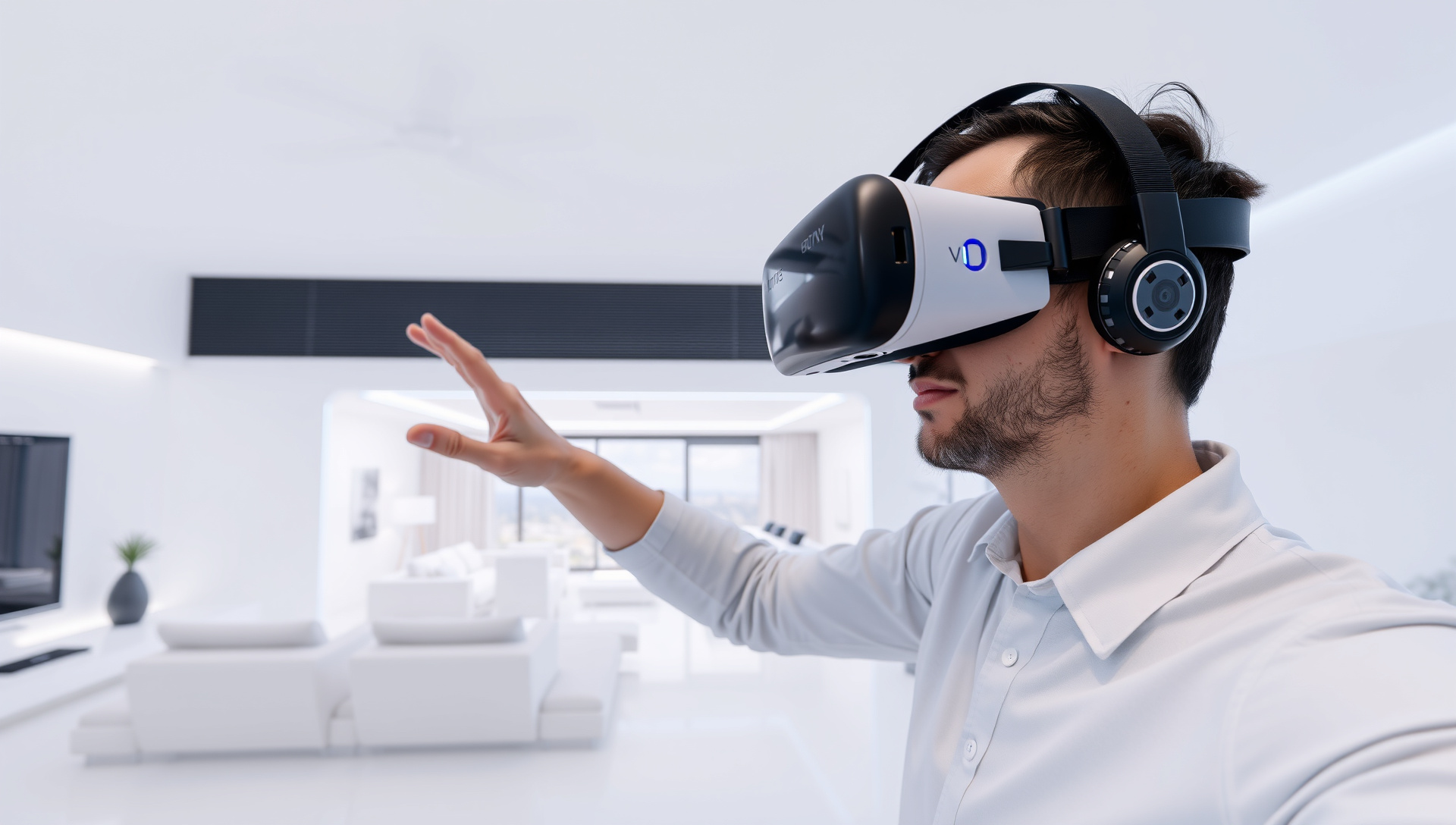
- VR headset immersive tours: The full experience — a buyer wears a headset and is spatially present inside the rendered environment, with head-tracking and depth. This is the highest-impact format for sales office centerpieces and property exhibitions.
- Interactive VR + configurator tours: Combines a VR walkthrough with live customization — buyers can swap flooring, wall finishes, or unit layouts inside the tour itself. This overlaps closely with interactive 3D sales tools and is increasingly used for premium and luxury launches.
How a Virtual Reality Tour Is Actually Produced
For under-construction projects, the production pipeline looks like this:
- 3D model build. The studio builds a detailed 3D model of the show flat, amenities, or entire project from architectural drawings and material specifications — the same base model often used for 3D renders and walkthrough videos.
- 360° render capture. Instead of a single fixed camera angle, the studio renders full 360° panoramic nodes at key points — entrance, living room, bedrooms, balcony, clubhouse — each one a complete spherical view.
- Hotspot linking and navigation. The panoramic nodes are stitched together with clickable hotspots so a buyer can move logically from room to room, floor to floor.
- Interactive layer (optional). Floor plan overlays, unit information pop-ups, material swap buttons, and lead-capture forms are added directly inside the tour.
- Multi-platform packaging. The finished tour is optimized for three delivery formats simultaneously: an embeddable web version for your website, a lightweight version for WhatsApp/social sharing, and a headset-ready build for the sales office VR station.
VR Tours vs 3D Walkthrough Videos vs Scale Models: Which One Do You Need?
These three formats are often confused, but they solve different problems in the buyer journey. Most well-marketed projects use a combination, not a single format.
| Format | Best For | Buyer Control |
|---|---|---|
| Virtual Reality Tour | Remote/NRI buyers, sales office VR stations, pre-launch sample flats | Full — buyer navigates freely, room to room |
| 3D Walkthrough Video | Website hero content, social media, brochures, ad campaigns | None — curated cinematic camera path |
| Architectural Scale Model | Physical sales gallery centerpiece, master plan and site context | Physical — buyer walks around and touches the model |
In practice, top developers pair all three: a cinematic walkthrough video for top-of-funnel marketing, a VR tour for serious, later-stage buyers to self-explore in detail, and a physical scale model in the sales gallery to close the deal in person.
What Does a Virtual Reality Tour Cost in India?
Pricing depends heavily on scope, but as a working benchmark for 2026:
- Single-unit 360° browser tour (show flat only): Lower cost, fastest turnaround — suitable for a single unit type or sample flat.
- Multi-unit project tour (multiple typologies, clubhouse, amenities): Mid-range, scales with the number of 360° nodes and interactive features required.
- Full VR headset experience with configurator: Highest investment — includes headset optimization, real-time material swapping, and often a dedicated sales-office VR station setup.
The biggest cost drivers are the number of distinct spaces covered, whether an interactive configurator layer is included, and whether the tour needs to run on a standalone VR headset (which requires additional optimization work) versus browser-only.
How to Choose a Virtual Reality Tour Company
Not every 3D studio that offers renders can build a properly navigable VR tour. Evaluate potential partners against these criteria:
- Portfolio of navigable tours, not just renders. Ask to actually walk through a live, hosted tour — not a video recording of one.
- Cross-device delivery. The same tour should work smoothly on a desktop browser, a mobile phone, and a VR headset without three separate rebuilds.
- Load-time optimization. A tour that takes 30 seconds to load a panorama will lose the buyer before they see the living room. Ask about compression and streaming approach.
- CAD-accurate modelling. The tour should be built from your actual architectural drawings and material board — not generic stock interiors that don't match what buyers will receive.
- Analytics and lead capture. The best tours report which rooms buyers spent the most time in and capture contact details mid-tour — turning the experience into a qualification tool for your sales team.
- Turnaround and revision policy. Confirm how many rounds of material/finish revisions are included before the tour is considered final.
Where VR Tours Deliver the Highest ROI
VR tours aren't equally valuable at every stage of a project. They deliver the strongest return in four specific situations:
Pre-launch sales, before any inventory is ready to show: A VR tour of the show flat lets you start booking against a property that physically doesn't exist yet.
NRI and outstation buyer segments: Pair the VR tour with a drone shoot of the actual site and a location advantage video and a remote buyer can evaluate the unit, the site, and the connectivity — all without booking a flight.
Property exhibitions and roadshows: A VR headset station at a property expo lets one team member run dozens of immersive tours a day, compared to a handful of physical site visits.
Multi-city or portfolio developers: A single VR-ready sales office format can be replicated across every city location without physically building a show flat in each one.
Common Mistakes to Avoid
Mistake 1: Treating a 360° photo gallery as a "VR tour." A handful of disconnected 360° images with no navigation or hotspots isn't a tour — it's a slideshow. Buyers notice the difference immediately.
Mistake 2: Building for headset only, ignoring mobile. Most buyers will first encounter your tour on a phone, shared via WhatsApp — not in a headset at your sales office. If the mobile version is clunky, you lose the top of the funnel.
Mistake 3: Skipping the lead-capture layer. A beautiful tour with no way to capture buyer intent partway through is a missed qualification opportunity — especially for anonymous website traffic.
Mistake 4: Using outdated material specs. If the tour shows a marble finish you've since swapped for a different material, you create a trust gap the moment the buyer visits in person. Keep the tour synced with your current specification sheet.
Real Numbers: The Business Impact of VR Tours
Developers who deploy VR tours alongside their standard marketing stack typically report:
- Higher inquiry-to-site-visit conversion: Buyers who've already "walked" the property in VR arrive at the physical site visit pre-qualified and further along the decision.
- Shorter sales cycles for outstation and NRI buyers: Fewer round trips are needed to confirm layout and finish decisions.
- Reduced sales office staffing load: A self-guided VR station handles walk-in footfall that would otherwise require a dedicated executive per visitor.
- Stronger performance in paid digital campaigns: Embedded VR tour links consistently outperform static image galleries on time-on-page and form-fill rate.
The Bottom Line
A virtual reality tour isn't a gimmick bolted onto your website — it's a sales tool that lets serious buyers self-qualify before your sales team spends time on them. For projects targeting NRI buyers, running pre-launch sales, or managing footfall across multiple sales offices, it's quickly becoming as standard as a floor plan PDF.
The developers seeing the best results don't treat VR as a replacement for renders, walkthrough videos, or scale models — they treat it as the layer that lets a remote or time-constrained buyer get 80% of the confidence of a physical site visit, entirely on their own schedule.
What to Do Next
If you're evaluating VR for an upcoming launch, start by identifying your highest-intent, lowest-conversion buyer segment — usually NRI or outstation buyers — and pilot a single-unit VR tour for that segment first. Measure inquiry-to-site-visit conversion before and after, then decide whether to scale the format across your full project or portfolio. Looking for a partner to build it? Explore our virtual reality tours service for portfolio examples and production timelines.
Ready to Build a Virtual Reality Tour for Your Project?
Talk to our team today and get a free consultation and quote for your real estate project.